Category: writ3152

  • WRIT 3152 | Week Five

    Week Five is Mon, 2/9 through Fri, 2/13.

    Reminder: No formal class on Mon, 2/9, due to our voluntary Georgia State Capitol field trip on that day (details here). You will have another opportunity next month on Mon, 3/23.

    Key practice: ethical image selection

    Although you are legally protected by the Fair Use provision of copyright law to use most images on a blog post composed for educational purposes, we will operate under different guidelines. In order to prepare you for the content creation/digital culture norms in the world beyond the university, I require that you practice “ethical image selection”, meaning that you avoid images that are protected by copyright. In our work you should use, instead, images that are available 1) within the public domain, 2) under a Creative Commons license, or 3) because they belong to you. You can read more about ethical image selection on Open Lab’s copyright guideline page (my guidelines are similar to theirs). All visuals that you use for publication in WRIT 3152 need to demonstrate ethical image selection, cite the owner, and hyperlink to the original license (if you found it online).

    Completing Week Four Activity blog posts (due Mon, 2/9)

    1. Change your title to one that matches the subject of your post.
    2. Choose an image to set as the “featured image” for your post, following the guidelines above.
    3. Navigate to the the “set featured image” button in the right corner of the post editing screen:


    3. Upload the image that you want to use.
    4. Begin your post with an attribution of the post that is justified on the right margin and in italics.
    5. See my citation of an Unsplash image or my citation of my own image as examples.
    6. Proofread carefully for mechanical and style issues.
    7. Click “publish” in the right-hand corner.
    8. Your post is now live on the site! Congratulations.

    Reading/Media

    1. Read “1, Implicit Feudalism: The Origins of Counter-democratic Design,” (pgs 17-39) the first chapter of Schneider’s book Governable Spaces: Democratic Design for Online Life.
    2. Choose three news or blog articles to read (whether published in the AJC or elsewhere) that relate to a specific legislative initiative (bill or topic) in the current Georgia General Assembly session.
    3. Complete the five lessons under the second module (“Gain a familiarity with the WordPress Interface”) within the Beginner WordPress User course (you should NOT need to sign up, pay anything, or click the “take this course” button). You should have already worked through the first module (“Getting started with WordPress) in our first week; if you did not, you should complete that step as well.

    Homework (due Wed, 2/11)

    1. Prepare a list of three impactful quotes from Schneider along with your observations about them (100 words each).
    2. Prepare three observations from your legislative/news reading on why you choose to study that bill/topic (100 words each).
    3. Prepare a descriptions of three skills that you learned during your WordPress tutorials that you would like to experiment with in your next blog post (100 words each).

    Class on Wed, 2/11

    As you can see, I’m asking you to complete a significant amount of work for next Wednesday’s class. Bring questions, concerns, thoughts, brainstorms, etc. to class for discussion. We will spend most of class as a workshop for all of the material that I have asked you to prepare. I will take a grade on everything I’ve asked you to submit above, and you will need to be in class (or have prior approval from me to submit the work during class) to receive credit.

  • Opening your WordPress user account

    We will go through this steps in class on Feb, 2/4. DM on Discord if you do not attend and need additional information. Everyone in the class needs to open an account.

    1. Currently our publishing site web domain is: https://env-3934933.us.reclaim.cloud/. That domain name will be changing within a couple of weeks.
    2. Navigate to the login page for that WordPress site: https://env-3934933.us.reclaim.cloud/login
    3. Use your KSU NetID as your username.
    4. I will be giving you the introductory password during class.
    5. Once you are logged in, use the Profile button (top right corner) to
      • change your Nickname/Display Name if you would like
      • change your password
    6. Familiarize yourself with the WordPress dashboard.
  • Georgia Capitol trip planning

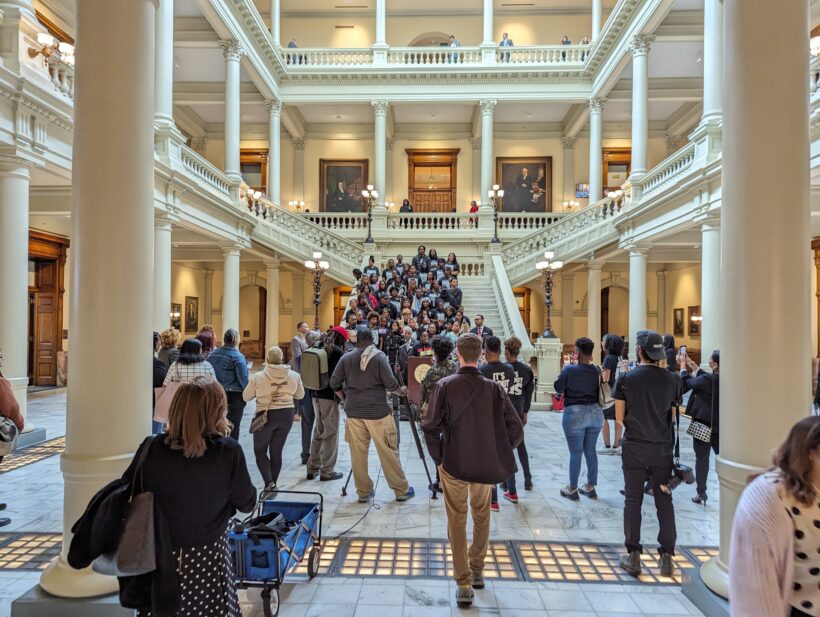
    We’ll be taking voluntary trips to the Capitol this semester on Mon, 2/9, and Mon, 3/23.

    For Mon, 2/9:

    1. If you plan to join me, put an emoji on this message in Discord.
    2. Prepare a list of lawmakers who you would like to visit regarding legislation that they have sponsored or those who represent your district.
    3. Bring a pad and pen for taking notes along with your phone for research and pictures.
    4. Wear comfortable but professional attire, as you may end up talking to and taking pictures with lawmakers.
    5. There are various places to park within several blocks of the Capitol, both street parking and parking decks. Unfortunately, none of it is free. If you decide to park at a Marta station, navigate to the Georgia State Marta Station, and the Capitol will be one block south along Piedmont Ave.
    6. The Georgia State Capitol is located at 206 Washington Street, Atlanta, 30334. The Governor’s Office webpage includes driving directions.
    7. Meet me at the southern entrance to the building, next to the fence along Capitol Square, SE, between 8.45a-9a (see the map below).
    8. I will enter the building with everyone who is there at 9am. Do not bring any weapons or anything you don’t want searched, as you have to go through a metal detector scan to get into the building.
    9. Once we get into the building, we’ll find a place to sit and I’ll orient you to the building.
    10. You’ll have from 9.30-12p to take a tour, talk to lawmakers, meet any of the Capitol staff and interns, observe press conferences/committee meetings, and talk with protesters/demonstrators.
    11. We will leave the Capitol between 12p-12:30p.

  • Week Four

    Reminders from last week:

    1. Read any four articles in the AJC’s Politics section published this week (1/27-2/1) and be prepared for a class discussion on the bills with the most “buzz” for this session.
    2. I did not post instructions for joining our WordPress site on Friday. We will do that in class on Wed, 2/4.

    Announcements:

    1. No formal class meeting next Mon, 2/9, due to our voluntary Georgia State Capitol field trip
    2. Here is the trip planning post for anyone planning to attend.

    Monday discussion:

    1. Legislative topics from your AJC reading
    2. Our Analysis Post template
    3. , which outlines the guidelines for the analysis posts for our class
    4. Come to class with 3 related artifacts; two must be social media stakeholders

    Wednesday activity:

    1. Measuring digital ethos
    2. Opening your WordPress accounts on our publishing space
    3. Open new post and start composing your first analysis using the 3 artifacts that you found for homework that uses: 100 words of introduction, 3 artifacts (at least two must be stakeholders), and 3 annotations following the model in Monday’s template and this, simpler, Week Four Activity Example post.
    4. Give the post a contextually useful title and place it in the “Week Four Activity” category (use the menu on the right side of your composing screen and choose “Post” at the top to find the drop down for categories).
    5. Complete the above steps and save the post in a “DRAFT” format (do not “publish” it) by the end of the day tomorrow (Thurs, 2/5).

    For completion before next week:

    Because we are missing class on Monday, our Week Five post on Friday morning will outline activities and readings for the weekend and next week.

  • WRIT 3152 | Week Three

    As class begins:

    1. Post reflection and analysis of Week Two stakeholder activity (during class)
    2. Creating threads, notes, and replies on the Week Two op-ed activity

    Announcements:

    1. Capitol field trips will be happen Monday, 2/9 (in Week Five) and Monday, 3/23. Monday, 3/23, will be our transit day from KSU.
      • Mark these events and attend if you can, but they are voluntary ways to complete an “experiential learning” activity that will be outlined next week.
      • Students can organize and take their own trips to Capitol without going with a group from class.
    2. Flow of course information/activity
      • Weekly posts on Friday morning will cover the coming week from Monday afternoon after class to the next Monday afternoon before class
      • Example: Week Four post, which I’ll add to and publish to Discord on Fri, 1/30)
      • Everything else happens in Discord. Be sure to follow #announcements, activities you’ve joined, and @you messages closely.

    For discussion in class today:

    “Democracy in the Wild” from the Welcome post in the first week of class.

    For completion by Sunday (2/1):

    Read any four articles in the AJC’s Politics section published this week (1/27-2/1) and be prepared for a class discussion on the bills with the most “buzz” for this session.

    Open a WordPress user account on our class site when instructions are posted on Friday (1/30).

  • WRIT 3152 | Week Four

    (Feb. 2-Feb. 8)

    In class:

    Activities to complete:

    Texts to read:

  • WRIT 3152 | Week Two

    We only have class once this week (due to the MLK holiday on Monday). In class on Wednesday we will discuss the following:

    In class on Wed., 1/21

    1. Grades on our first six activities
    2. Choosing dates for our Georgia Capitol field trips (1.25p chooses a range of 4 dates; 2.30p narrows to 2)
    3. Looking at the Georgia General Assembly website
    4. Smart links (class definition)
    5. Defining and locating “stakeholders” (according to our class definition)
      • Politicians (both elected and political party employees)
      • Journalists (professional journalists whether freelance or committed to a media company or organization)
      • Stakeholders (living in Georgia, arguing to/for Georgia citizens)
    6. Discussion: “Democracy in the Wild” by Schneider
    7. Look for a Week Three post on Fri, 1/23.

    Activity: Gathering social media posts

    • Join one of the teams published as separate threads in the #activities channel on Discord (5 people max to a team) with a “hello” into that team’s channel by the end of today (Wed, 1/21).
    • Identify a project manager (PM) — someone who will agree to organize the group’s work as 50% of their work on the project. Organizing involves facilitating, answering questions, surveying opinions, and communicating deadlines. You can make this choice with a volunteer, a vote, a random draw, or some other method, but be sure the method is clearly communicated in the thread.
    • PM should either open an organize a document all team members can use collaboratively or offer to organize the material in the channel into a document themselves. The PM should communicate this choice to the group by Thurs, 1/22.
    • Each group member should find 2 tweets (on X/Twitter) from each of the following categories: 1) Georgia state politicians (check our spreadsheet if it’s helpful); 2) Georgia journalists or media companies; and 3) Georgia stakeholders who are neither politicians (including political parties or party employees) or journalists. Tweets should be no older than the current session of the General Assembly and should address something related to the work of the current session. PM’s choose 1 tweet instead of 2 for each category. Tweets should be added to the group in the format decided on by the PM by Fri, 1/23.
    • PM needs to confirm that each tweet fits its intended category and communicate to team members if they need to find replacements.
    • Start building a list of useful accounts on X/Twitter.
    • Compose 100-200 words of reflection on the methods that you used to find your tweets (PM is exempt from this requirement). Have that language ready to share (as a copy/paste) in class on Mon, 1/26.
    • Compose 100-200 words of analysis connecting the tweets collected by the group. In your analysis concentrate on providing explanation, narration, and/or a concrete argument that connects some of the content of the group. Be sure that your analysis refers to specific social media posts and uses smart links to hyperlink to them. Have that language ready to share (as a copy/paste) in class on Mon, 1/26.

    Reading/media for Mon., 1/26

    1. Spend some time exploring the Georgia General Assembly website.
    2. Read Rep. Mary Margaret Oliver’s AJC op-ed from 1/16 on affordable housing.
    3. Choose one of the bills referred to in the op-ed, find it on the GA website, and read it thoroughly.
    4. Compose some notes on what you learn about the content of the bill and the form of the bill, roughly 100-200 words each.

  • WRIT 3152 | Week One

    In class Monday, 1/12, I’ll be doing brief introductions; then, I will be discussing:

    1. The Welcome post activities and the general shape of the class
    2. Our importance of our ongoing definition of a “stakeholder”
    3. WordPress software and development
    4. The differences between federal and state representation

    We will conclude with my description of an activity, due on Wed., which will require you to enter your Congressional level senators and reps and your State level senators and reps into a spreadsheet (look for that link in #activities on Discord).

    Don’t forget to complete all of the activities in the Welcome post required for Wed, 1/14 (including the AJC reading).


    In class on Wednesday, 1/14, we will be:

    1. Completing an index card activity.
    2. Discussing what you learned by looking up your state rep. and state senator.
    3. Orienting to WordPress and the differences between proprietary and open source software.
    4. Discussing your AJC reading from the Welcome post (“Will Georgia lawmakers revive ..”)

    Remember that we will not have class on Mon, 1/19, on the Dr. Martin Luther King, Jr. holiday.

    For Wednesday please complete the following:

    1. Read the book chapter from the Welcome post (“Democracy in the Wild”).
    2. Read “The Georgia General Assembly begins the 2026 legislative session” in the AJC
    3. Listen to Politically Georgia, “Back Under the Gold Dome” episode (33 mins).
    4. Take a tour the Georgia General Assembly website to discover it’s functionality.
    5. Work through the five lessons under the module “Getting Started With WordPress” on learn.wordpress.org.
  • Welcome to Spring 2026, WRIT 3152/Digital Community Engagement

    Welcome to Spring 2026, WRIT 3152/Digital Community Engagement

    Welcome to our first class meeting; I’m using this post to share several resources that are important to starting our work together this week.

    This is a non-traditional class. We will be studying Georgia politics and the current General Assembly session through the lens of local stakeholders on social media, and we will be analyzing and evaluating the engagement strategies of those stakeholders (those are the “what” of the class). At the same time, the class will expose you to experiential learning, collaboration methods, online publishing, and project management skills (those are the “how” of the class). I am interested in introducing you to a simulated workplace environment, giving guidance when I can, and encouraging you to learn and grow in the directions that match your interest.

    Here are some things that you need to know and do to get started!

    Discord

    I use this Discord for a large portion of activities and communication this semester. Discord will not be used to post grades or any other FERPA protected materials. If you have an issue or question about the use of Discord, please reach out to me.

    1. Create a Discord account that uses your KSU email account. This may require you to build a separate Discord account than the one they already have (if you’re already a Discord user).
    2. Use the link below to join our class Discord server, and join with an account that uses your KSU email.
    3. Set your username on our server to be the first name that you choose to go by in class and the first initial of your last name.
    4. Choose an avatar/picture for your account if you would like.
    5. After you have joined, email me a screenshot of the “My Account” tab under your profile that allows me to see your username/display name, avatar, and KSU email address all in one place (here’s an example of what the looks like in my account). The subject line of that email should be: Discord Verification for WRIT 3152

    WRIT 3152: Digital Community Engagement, Discord “join” link

    Upon joining, I recommend that you immediately revise the Discord notifications so that you only receive notifications from the #announcements and #help channels in addition to posts or DMs sent directly to you. This will keep your KSU inbox from getting flooded with emails for every conversation on our server. Here is a resource page on Discord notifications.

    You may choose to interact with Discord for our class via a web browser, the Discord app on your phone, or both. I do not expect immediate, synchronous response to Discord material, but I do expect that you are checking Discord for relevant messages at least every other day (and sometimes more frequently during collaborative projects).

    Syllabus

    Our syllabus is posted under the “Syllabus” tab in D2L. Please read it carefully.

    Media

    Per the syllabus, you will need to purchase a subscription to The Atlanta Journal and Constitution. For new users, this subscriptions are offered at a reduced rate of 99 cents for 3 months; this will mean that you will only need to pay the regular price of $9.99/month for the final month of the semester.

    You will need to open an account at X (formerly known as Twitter) in order to be able to search tweets for major stakeholders. You will also be encouraged to develop facility with at least one social media platform that proves useful for research related to Georgia politics at the state level.

    You do not need to purchase any textbooks for this class. I will be linking articles and e-book chapters as readings.

    Activities

    • Join Discord (see above); remember to send the email mentioned above.
    • Complete an introduction for yourself in the #introductions channel on Discord. The guidelines at the top of the channel; please read them carefully.
    • Read the syllabus (within D2L); complete the activity related to the syllabus in #activities.
    • Read the “Communication Protocols” section of this blog post; post questions in #help if you have any.
    • Look for the Week One blog post that will be posted in #announcements before class begins on Mon, 1/12. Leave an emoji on that post when you see it.
    • Read the following article by Wed, 1/14:
    • Read the following article by Wed, 1/21:

    During our first day of class this week, I will discuss the regular flow of our in-class and hybrid work.

    I do not use D2L email/messaging, so do not message me there. If you miss the first class or have any questions after attending, email me: pete@kennesaw.edu. You can always schedule time with me for a f2f or virtual meeting on my Bookings page.

  • WRIT 3152 | Communication and Collaboration Protocols

    WRIT 3152 | Communication and Collaboration Protocols

    Photo by “My Life Through A Lens” on Unsplash

    Communication Protocols (on Discord)

    1. Reactions/emojis for “I saw this” or “yes/no” voting.
    2. Use polls for standardized data collection that leads to decision making (picking times to meet, for example).
    3. Use threads when you’re looking to share resources or for more involved conversation.
    4. Remember @name usage; use replies when applicable. One or the other will alert the user (you don’t need both).
    5. Use pins (and turn them off when finished with them); look for pins if you’re uncertain/lost.
    6. Voice channels are useful; I’ve made three of them that any group can use at any time.
    7. Don’t forget the #help channel (both to ask and answer questions).
    8. Turn on notifications for at least: #announcements, @everyone, and your @ mentions
    9. If you get involved in a synchronous conversation (of more than a couple of real-time exchanges), avoid ghosting (leaving the conversation without an explanation).
    10. Thank people for help they provide.

    Collaboration Protocols (during activities)

    1. Give team members at least 24 hours to respond for short or expected requests.
    2. Give team members at least 48 hours for questions that are unexpected or require more thought.
    3. Ask directed questions instead of open ended questions (not: “when is everyone free?”, but: “what is your availability between 8a-12p on Friday, Sept. 12”).
    4. Provided requested answers instead of meandering feedback.
    5. Of course emergencies and unexpected events happen, but plan ahead, not behind by being clear and realistic about your schedule and boundaries.
    6. Don’t let something that is slowing you down slow down your team; briefly explain your situation and empower the team to move on without you.
    7. If you are falling behind in collaboration, reach out to notify me if you decide that you should not be evaluated the same as your team members; this may result in your being pulled from a team and/or given a different assignment, but it’s better for me to know this from you than from your team evaluation.
    8. Make an agenda for a meeting (even if it’s just three short bullet points) and share it; when there is time, it’s usually best to collaborate on an agenda (to invite others to add things).
    9. Identify a note taker for every meeting and post notes
    10. Do not count a meeting if more than one team member is absent.
css.php